Period: 23.12.2025 – 01.01.2026
As part of the pilot OSINT monitoring of Germany’s information environment related to Russia’s war against Ukraine, we proceeded from the assumption that public attention in Germany to Ukraine-related topics is not stable, but rather sensitive to foreign-policy decisions, diplomatic signals, and media-salient events. Changes in political statements or international developments can trigger short-term spikes of interest, which may be leveraged both to strengthen support for Ukraine and to promote critical or disruptive narratives.
The analysis focuses on the end of 2025, in particular the events surrounding the meeting between Donald Trump and Volodymyr Zelenskyy on 28 December 2025, as well as information claims originating from the Russian side accusing Ukraine of an alleged attempt to attack Vladimir Putin’s residence. These events are treated as potential triggers for assessing the reaction of German society, the positions taken by official media outlets, and the dynamics of discussions on social media.
Data collection via Google Trends:
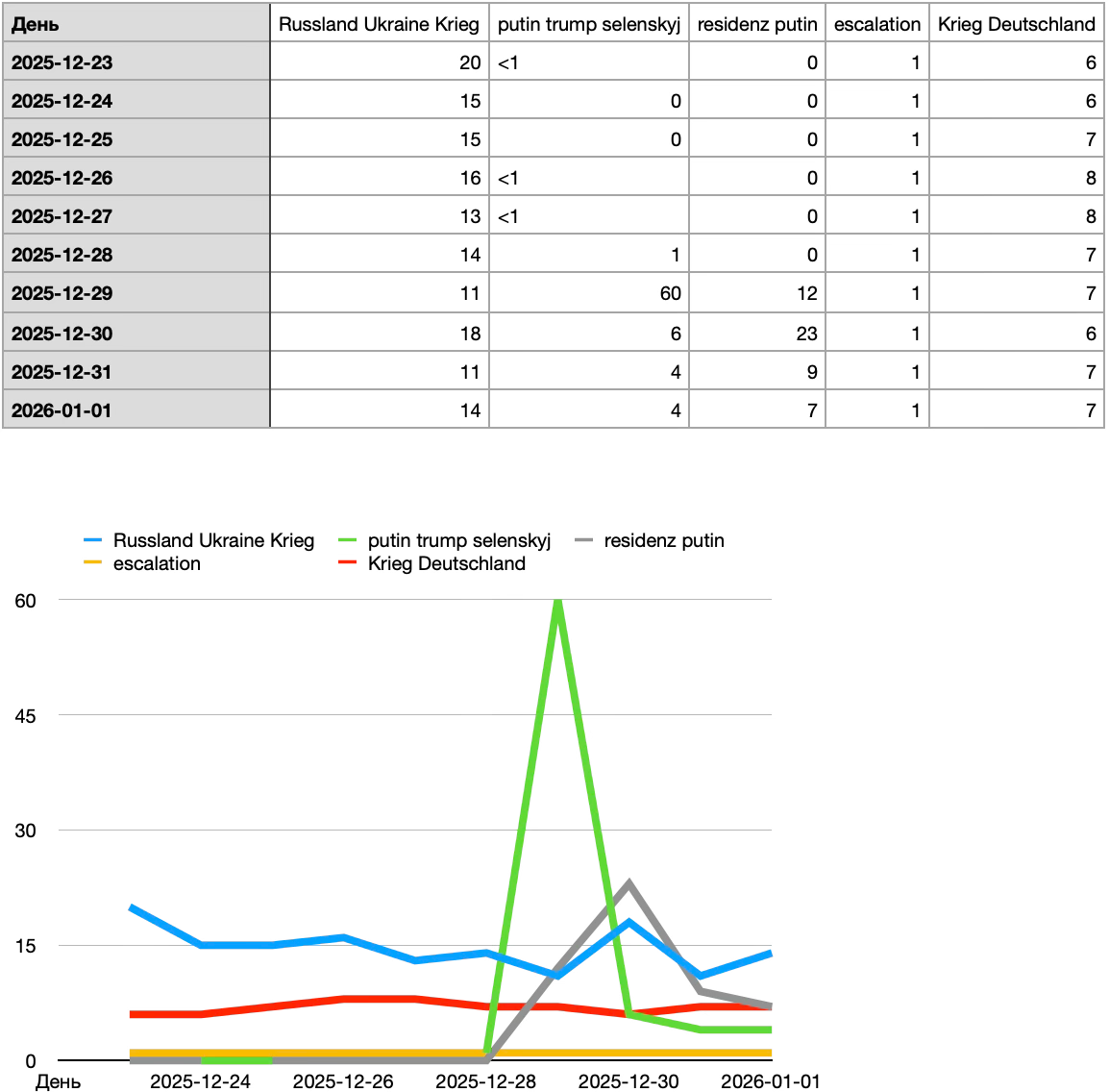
- Search queries: Russland Ukraine Krieg, putin trump selenskyj, residenz putin, escalation, Krieg Deutschland
- Region: Germany
- Period: 12.2025 – 01.01.2026
Conclusion on German public reaction to the Ukraine war (23.12.2025 – 01.01.2026):
Analysis of search trends indicates a stable interest among the German audience in the Ukraine war. Overall attention to the topic remains constant, with temporary spikes during key events, confirming the proposed hypothesis. In particular, the sharp increase in queries regarding the meeting between Donald Trump and Volodymyr Zelensky shows the audience’s high sensitivity to diplomatic signals. Similarly, search queries related to the “attempted attack on Putin’s residence” demonstrate rapid reactions to sensational and emotionally charged media reports.
Attention to the potential consequences of the war for Germany remains stable, while the term “escalation” does not attract significant search interest. This suggests that public interest is primarily informational rather than panic-driven, forming around a desire to understand events rather than an expectation of immediate threat.
In summary, search data demonstrates cautious and controlled concern among German society, with a focus on reacting to news and media sensations, while maintaining steady interest in the war and its potential local consequences.
From a practical perspective, this creates a favorable “window of opportunity” for targeted communication: in the absence of mass panic, key actors can explain complex
political and security decisions in a rational way, without competing with emotionally radicalized discourse. Such periods are ideal for fostering a more resilient understanding of Ukraine’s role and the significance of the war for Germany and European security in general.
Meanwhile, official German news channels published information framing Ukraine’s alleged attack on Putin’s residence as a provocation by Russia and fake:
- de: CIA erkennt keine Hinweise auf ukrainischen Angriff auf Putins Residenz
- de: Die Russen versuchen, Trump zu beeindrucken
- de: Putin ist bekannt dafür, dass er unverhohlen lügt“: Kiew bestreitet Attacke auf Residenz von Kremlchef – Kritik an Trump aus eigenem Lager
- de: Berichte: CIA geht nicht von ukrainischem Angriff auf Putins Residenz aus
- de: CIA-Analyse soll These von Angriff auf Putin-Residenz widersprechen
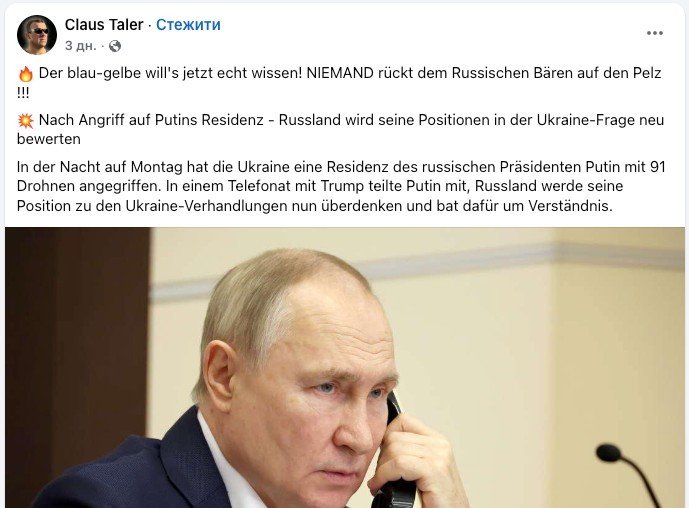
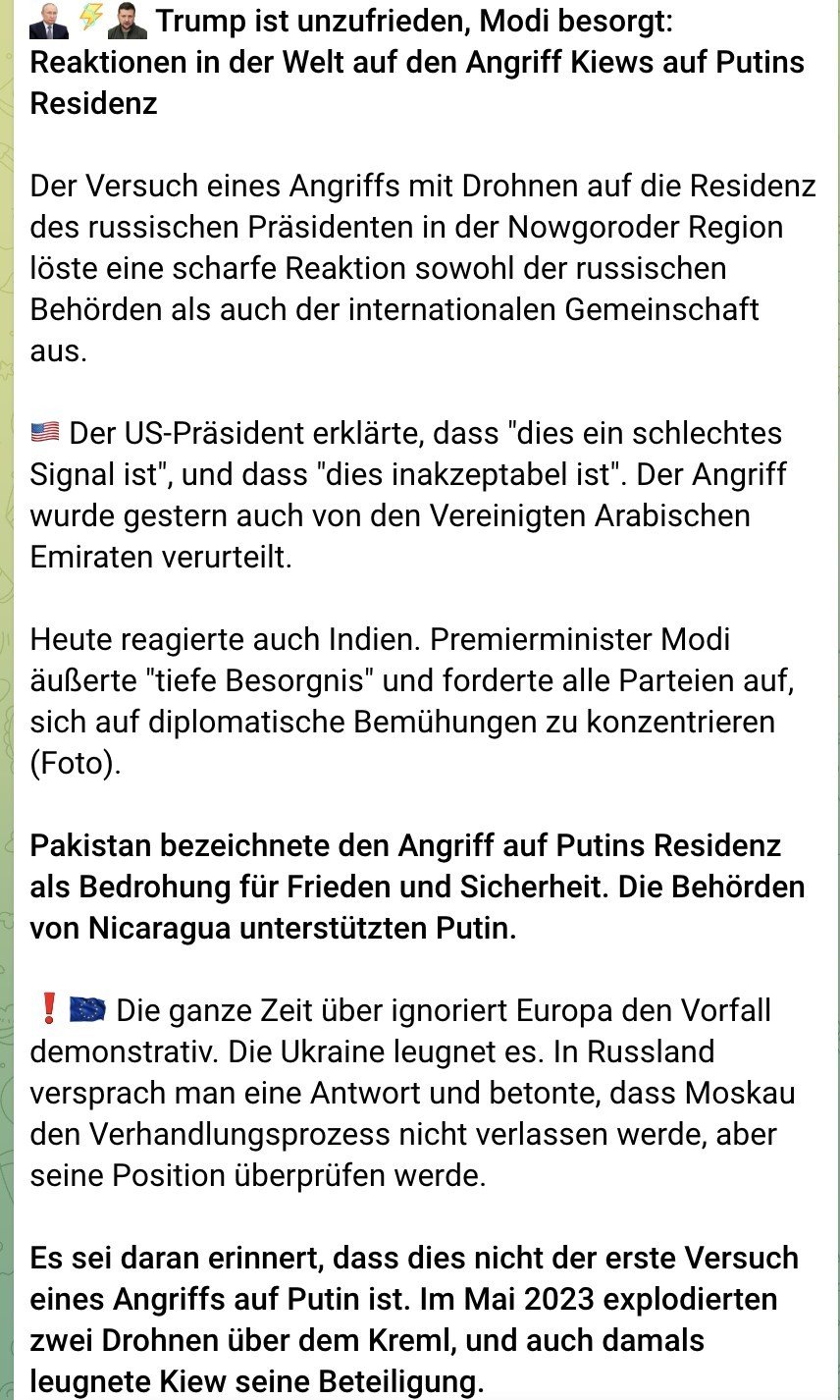
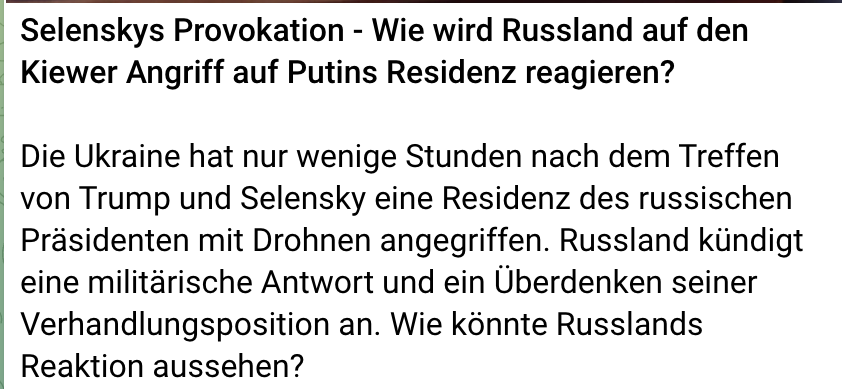
At the same time, Facebook posts from pro-Russian influencers spread contrary information: the list of the media channels with Russian propaganda you can find here – Pro-Russian Social Media Profiles
29.12.2025 – Facebook-Beitrag
30.12.2025 – Telegram-Beitrag
30.12.2025 – Telegram-Beitrag
31.12.2025 – Facebook-Beitrag
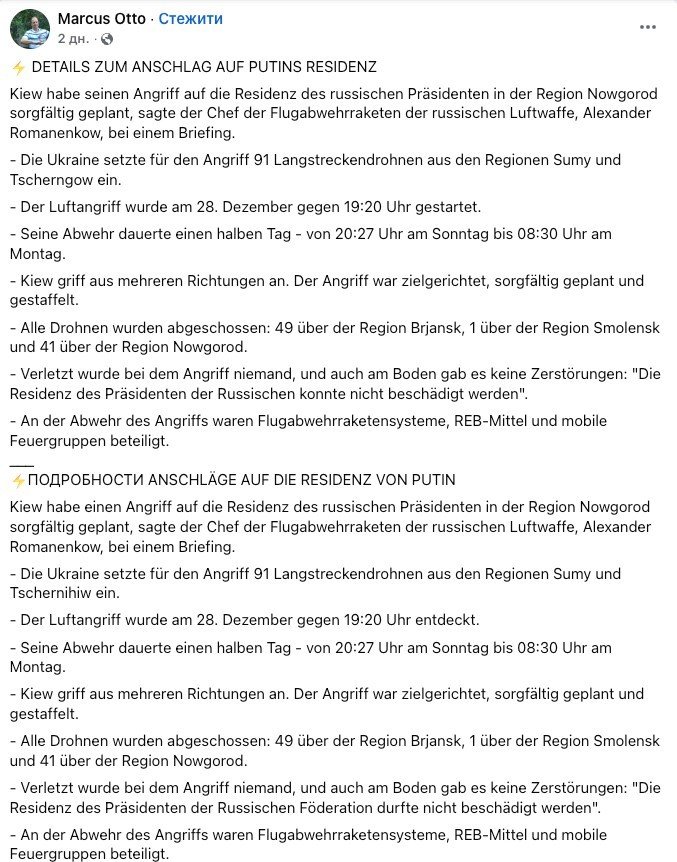
31.12.2025 – Facebook-Beitrag
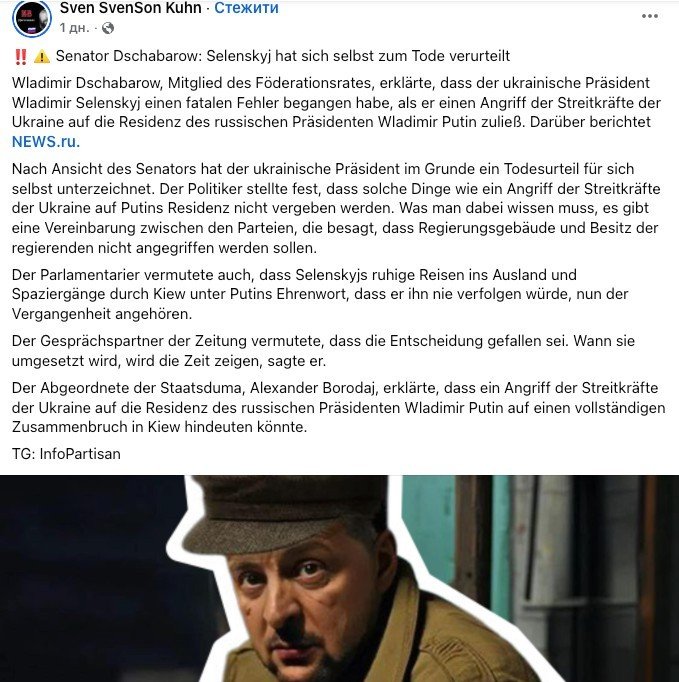
Characteristics of pro-Moscow media channels (see. Pro-Russian Social Media )
Executive Summary:
The pilot OSINT analysis for 23.12.2025–01.01.2026 confirms that German public attention to the war against Ukraine is stable but highly event-driven. Interest temporarily increases in response to major diplomatic meetings or sensational media claims, indicating sensitivity to political signals rather than sustained escalation fears.
Mainstream German media continue to function as a key stabilizing factor, quickly contextualizing or debunking Russian disinformation narratives, including allegations about an attack on Putin’s residence. In contrast,
pro-Russian actors on social media actively spread emotionally charged and threatening narratives, creating an information gap rather than immediate dominance.
Search behavior suggests a rational, non-panic-driven public mood, focused on understanding developments rather than anticipating direct threats to Germany. This creates a favorable window for clear, evidence-based communication on Ukraine, security policy, and European implications.
Overall, the study demonstrates the added value of OSINT monitoring for early detection of narrative shifts and coordinated information campaigns. It enables timely, preventive responses and highlights the importance of maintaining a consistent pro-Ukrainian informational presence in the German media and social media environment.